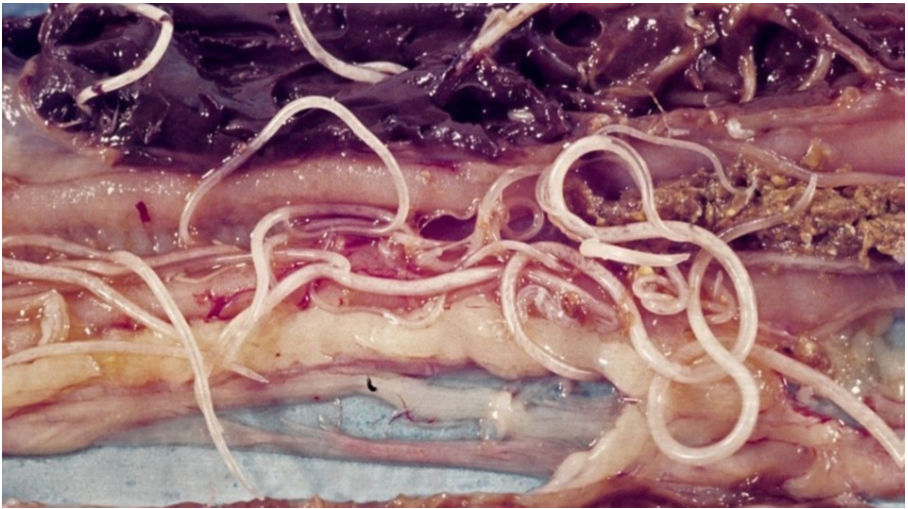
Grindworms that often attack chickens
(Source : https://layinghens.hendrix-genetics.com/en/articles/helminthiasis-worms/)
Hindro Setyawan, S.Pt
Technical Support – Research and Development PT Mensana
Worm infestation remains a common health problem in poultry, affecting both laying hens and broilers. Although it is generally not fatal, the economic losses it causes can be substantial—especially under current conditions where feed prices have increased significantly
More often than not, Worm infections develop gradually and often go unnoticed. However, over time, they can lead to a significant decline in egg production and growth performance. In the early stages of infection, chickens typically do not show obvious clinical signs. Feed consumption also appears normal. Reductions in body weight or egg size are usually not detected unless production records are closely monitored. In many cases, worm infestations go unnoticed even when egg production has already declined significantly, as farmers and animal health personnel tend to focus more on bacterial or viral diseases
The most common worms infecting chickens include roundworms and tapeworms. A meta-analysis conducted by Anwar Shifaw et al. (2021), published in Poultry Science, analyzed 2,985 articles published between 1948 and 2019. The study reported that the most prevalent worm species infecting chickens were Ascaridia galli (35.9%), Heterakis gallinarum (28.5%), Capillaria spp. (5.9%), and Raillietina spp. (19%)
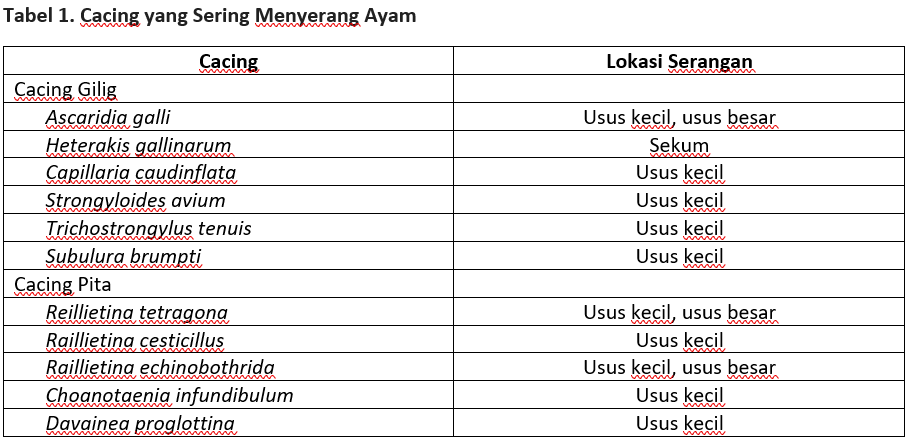
Source : Ohaeri and Okwum, 2013
Data on worm identification in Indonesia were reported from one of the major laying-hen production areas, Udanawu, Blitar. A study conducted by researchers from Universitas Airlangga (Klalissa et al., 2023) showed that out of 96 samples collected, 81.25% tested positive for worm infection. Further identification revealed that 66.67% were infected with Ascaridia galli, 45.83% with Heterakis gallinarum, 31.25% with Raillietina spp., and 7.29% with Strongyloides avium
It is highly recommended to build a farm-specific database of the types of worms that frequently infect or threaten poultry on each farm. Laboratory examinations should be conducted to detect the presence of worms on the farm
Worm infection identification is generally carried out using two methods: 1. Post-mortem examination to observe the presence of adult worms, and 2. Fecal examination to identify worm eggs (fecal flotation followed by microscopic observation). Routine worm identification should be performed, especially during the rainy season or when there in on insect and fly populations in crease in the poultry house
Worm infestations are often ignored by farmers. Usually, farmers only become aware of the problem once egg production has declined significantly. In reality, worms in the digestive tract “steal” nutrients from the feed that should be used for growth and egg production
• Identify the Presence of Worms and Their Eggs
Observe fecal conditions, particularly when insect and fly populations increase. In severe worm infections, adult worms or parts of worm bodies containing eggs (gravid proglottids) may be visible in the feces. In addition to direct observation, fecal samples should be collected and examined microscopically in the laboratory
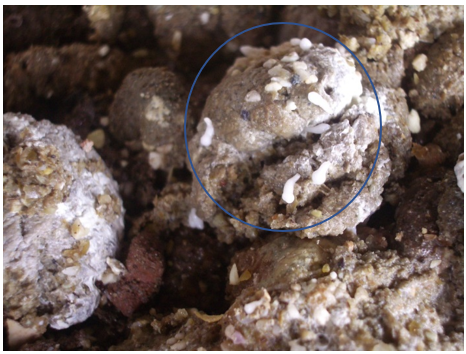
Proglottid Gavid found in feces
Early identification is extremely beneficial for breaking the infection cycle and enabling prompt treatment. It is important to remember that worm infections progress slowly but steadily. Early detection helps minimize losses due to reduced production and increased medication costs. Moreover, weight loss in chickens will delay the recovery of egg production, as consumed nutrients will first be used to restore body weight before being allocated for egg formation
In addition to fecal observation, production data should also be evaluated. In the early stages of worm infection, egg production may remain stable, but egg weight usually declines first. Therefore, egg weight and size should be closely monitored. Regular body weight control is also essential and should be performed at least once a month
• Select the Appropriate Anthelmintic According to Worm Type
Choosing the correct deworming drug is critical for successful treatment. Drugs effective against roundworms (nematodes) differ from those used for tapeworms (cestodes). Therefore, identifying the worm species involved is vital
Piperazine-based drugs (Piperamas) are highly effective against roundworms, as is levamisole (Levamas). For tapeworm infections, niclosamide-based drugs (Niclomas) can be used. In cases where both roundworms and tapeworms are present, albendazole (Albenmas) or a combination of levamisole and niclosamide (New Niclomas) may be applied
• Proper Application of Drugs
Drugs must be consumed at the correct dosage to ensure effectiveness. Make sure all chickens receive the appropriate amount. Anthelmintics can be administered through drinking water or feed. If necessary, fasting for 1–2 hours prior to treatment can be applied to improve drug intake
Drug dosage should be calculated based on body weight, as this provides the most accurate results. Although farmers may feel that the calculated amount seems excessive, dosing based on body weight is the correct approach. When administering dewormers via feed, mix the drug into a portion of the feed consumed within 1–3 hours. Typically, 30–40% of the daily feed allocation can be used for effective mixing. Ensure the drug is evenly distributed, as mixing in feed is generally more challenging than administration through drinking water
• Break the Worm Life Cycle
Understanding the worm life cycle is essential, as successful control cannot be achieved without it. Breaking the life cycle prevents reinfection of healthy chickens. Special attention is required in deep-litter housing systems without slatted floors, where worm transmission occurs more rapidly. However, even in battery cages, transmission can still occur through insects such as flies and beetles
Image 1. Life cycle of tapeworm (Davainea proglottina)
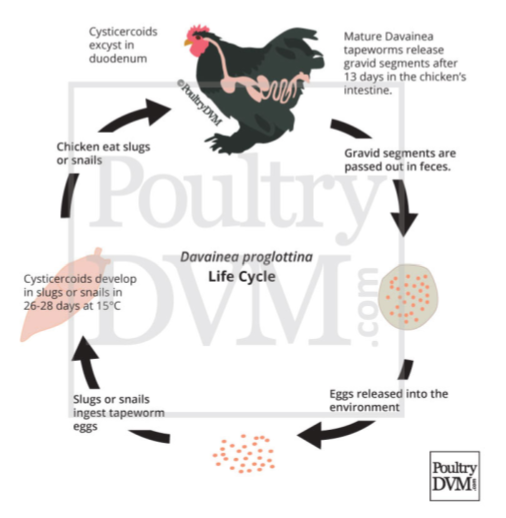
Source : https://www.poultrydvm.com/
Image 2. Life cycle of the roundworm (Ascaridia galli)
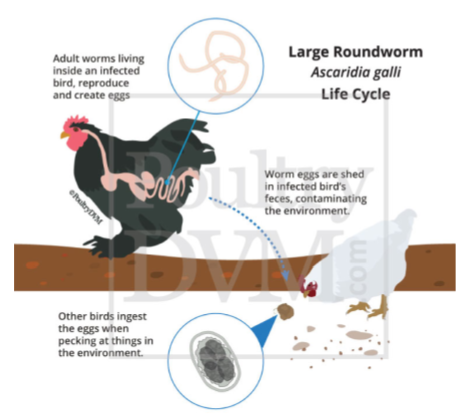
Source : https://www.poultrydvm.com/
Breaking the worm life cycle prevents the worms from infecting healthy chickens. Extra care must be taken when chickens are kept in slatless postal cages, as worms spread more rapidly. However, even battery cages can easily transmit worms if insects (flies) play a role.
Identifying worm eggs in feces is a highly effective step in controlling infections. Under optimal temperature and humidity conditions (around 25°C), Ascaridia galli eggs can survive in feces for up to eight months. Regular removal of feces during worm outbreaks is therefore very effective in breaking the life cycle. Eliminating intermediate hosts such as flies, snails, and insects is also crucial for controlling tapeworm infections
• Evaluate Treatment Effectiveness
Always evaluate the success of worm control measures. Observe fecal conditions, perform post-mortem examinations if necessary, and monitor production records. If treatment is successful, egg production will gradually recover. The speed of recovery depends on the severity of the infection—the earlier the detection, the faster the recovery
Repeat treatment may be required, especially in cases of heavy infection. A follow-up treatment at intervals of 10–14 days is recommended to help break the remaining life cycle within the digestive tract. Routine feces removal and insect control should also be done
Worms are “nutrient thieves” that deprive chickens of nutrients needed for growth and egg production. Although not fatal, the economic impact can be enormous. Early detection of worms and worm eggs is essential. Production records—especially egg weight, size, and production levels—should be monitored more carefully, particularly during the rainy season or when fly and insect populations increase. Hopefully, worm infections can be effectively anticipated and controlled. Wishing success for all of us
